
Visit one retailer after another to find the same products.
← All projects
Case study / 2026
Commerce Competitive Intelligence
A reproducible portfolio system combining Python data contracts, retailer parsing, deterministic business rules, evidence-linked LLM recommendations, and manually triggered n8n delivery to optional Google Sheets and Gmail adapters.
View source on GitHub ↗The story
Suppose I run an online store.
I would want to know how much competitors charge for the same products, whether they suddenly changed prices or ran out of stock, and what customers have been saying lately.
Compare prices, stock availability, and recent customer reviews.
Organize the findings, spot unusual changes, and decide what deserves attention.
The information is found. But tomorrow, I have to do it all again.
So I asked a different question.
What if the system could do the searching, comparing, and checking for me?
01CollectPages · Reviews
→ 02UnderstandParse · Normalize
→ 03DetectRules · Events
→ 04ExplainEvidence · AI
→ 05DeliverActionable alert
The result
I no longer have to search everywhere to find out what happened. The things worth noticing come to me.
See the actual notification email →The actual result
This is what arrives at the end of the workflow.
Instead of searching across sites myself, I receive the price gaps, stock events, review evidence, and recommendations that deserve attention. Final decisions remain with people.
Demo data · not live market information
COMPETITIVE INTELLIGENCE
DEMOMarket monitoring briefing
Priority events
CRITICALSony WH-1000XM5 · Best BuyOut of stock
WARNINGApple AirPods Pro 23 competitors below own price
WARNINGBose QuietComfort3 competitors below own price
Recommended actions
- Review Sony inventory availability and merchandising plan.
- Review AirPods price position; require human approval before changes.
- Review Bose price position; require human approval before changes.
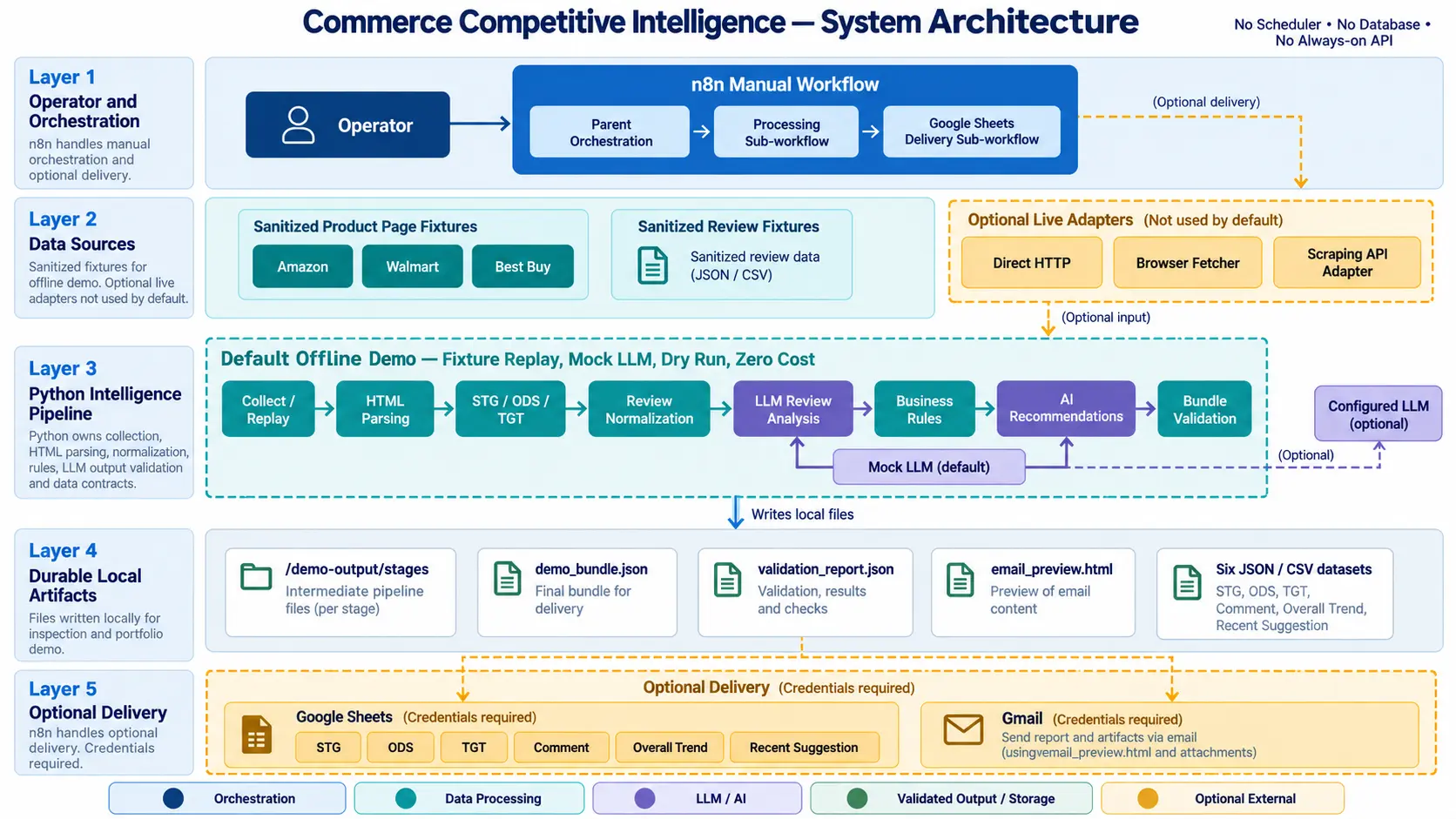
System architecture
Rules first. AI within a controlled boundary.
The quick view makes the core path immediately readable; the full diagrams remain visible for deeper inspection.
SOURCEFixturesPages · Reviews
→PIPELINESTG · ODS · TGTParse · Normalize
→INTELLIGENCERules + AIEvents · Suggestions
→DELIVERYValidated bundleSheets · Email
DEFAULT MODEFixture replay · Mock LLM · Dry run · Zero credentials
Detailed architecture
View full size ↗Full system architecture
n8n workflow
View full size ↗Manual orchestration and guarded delivery
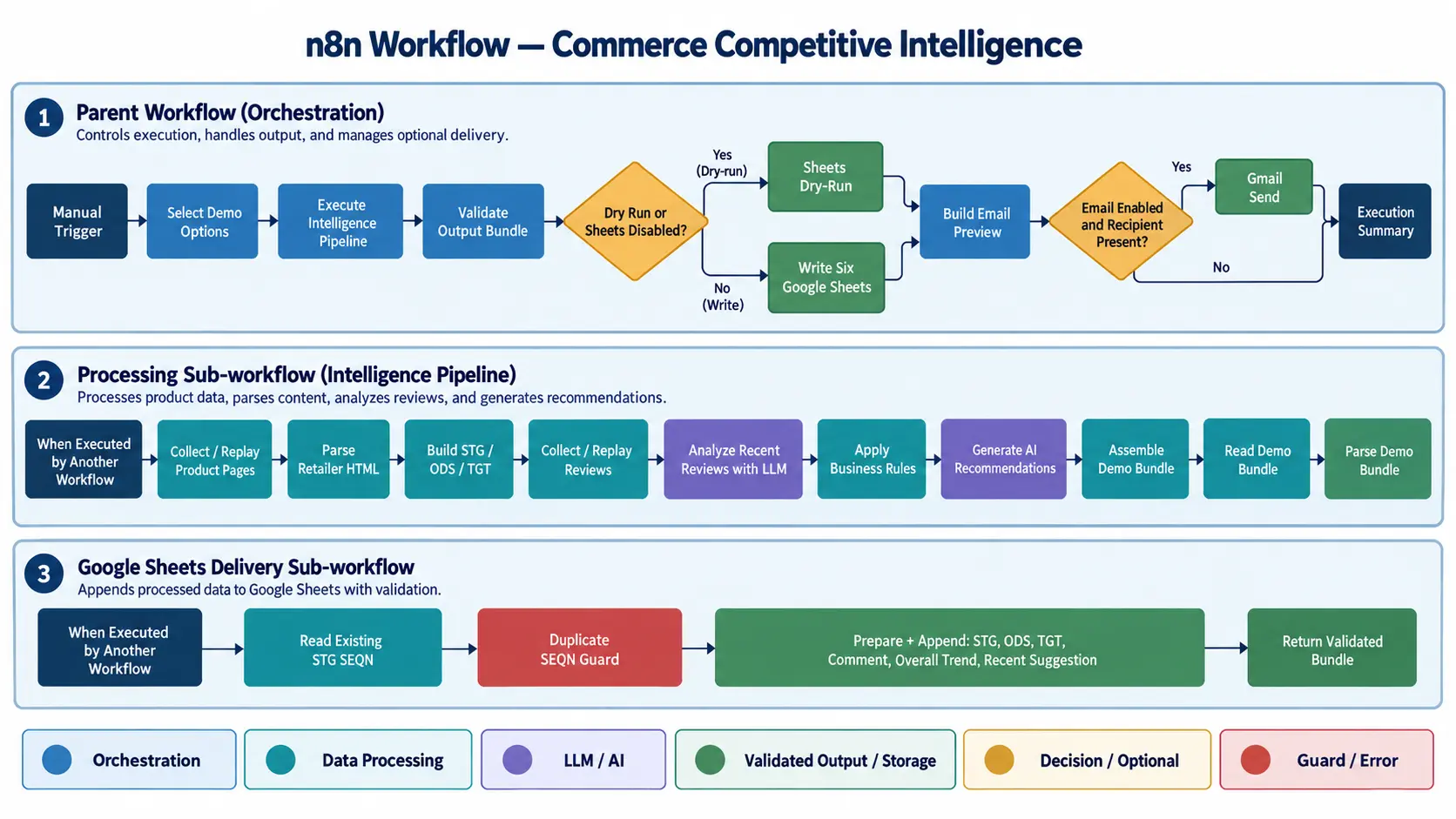
The parent workflow validates every bundle before optional delivery. Dry-run and duplicate-SEQN guards prevent accidental writes.
Overview
A portfolio demo built like an auditable system.
A reproducible portfolio system combining Python data contracts, retailer parsing, deterministic business rules, evidence-linked LLM recommendations, and manually triggered n8n delivery to optional Google Sheets and Gmail adapters.
Problem
Problem
Commerce teams often compare prices across retailers, check stock, read reviews, and assemble recommendations by hand. The work is repetitive, difficult to audit, and easy to disconnect from its evidence.
Goals
Goals
Build a reproducible intelligence pipeline that turns product pages and reviews into validated datasets, deterministic business events, evidence-linked AI recommendations, and optional delivery through Google Sheets and Gmail.
Key Engineering Decisions
Key Engineering Decisions
Business rules establish price and stock facts before the LLM writes recommendations. Fetchers, parsers, LLM providers, Sheets, and Email are replaceable adapters. The default demo remains offline, credential-free, deterministic, and safe to rerun.
Automation Workflow
Automation Workflow
A manual n8n parent workflow selects demo options, runs and validates the Python pipeline, then applies dry-run and credential gates before optional Sheets or Gmail delivery. Processing and Sheets delivery are isolated as focused sub-workflows.
Data Contracts
Data Contracts
Every run produces six schema-checked datasets: STG, ODS, TGT, Comment, Overall Trend, and Recent Suggestion. A shared SEQN links the outputs while rejected-row and evidence artifacts keep transformations traceable.
Quality & Security
Quality & Security
CI verifies formatting, types, tests, coverage, dependency audit, secret scanning, and the offline end-to-end demo. Credentials, cookies, live captures, and local output are excluded from the repository.
Demo Scope
Demo Scope
This reproducible offline demo presents the complete data-processing and automation workflow with sanitized fixtures, a mock LLM, and dry-run defaults. Google Sheets and Gmail are optional integrations that can be enabled with the required credentials.
Source